Master the Disaster: Preparing for Storm Season
Fall and winter weather are unpredictable. Cool, crisp sunshine one day could turn to gale-force winds and torrential rains the next.
As northwest residents, prolonged inclement weather aren’t anything new, but with each and every storm comes new lessons and a need to better understand the efforts being made to keep life on the Peninsula moving forward.
We hope you can join us on Tuesday, Nov. 4, from 10:30-Noon at the Jefferson County Library located at 620 Cedar Ave. in Port Hadlock for a talk outlining the essentials for winter preparations. Hear firsthand how the PUD and Jefferson County Public Works clear the path to get services moving during and after a storm.
The monthly emergency preparedness speaker series, provided by the Jefferson County Dept of Emergency Management, is a collaborative effort between groups helping to support our county’s emergency preparedness and response efforts. Groups including Neighborhood Preparedness (NPREP), the Volunteer Emergency Communications team (VECOM), the Community Emergency Response Team (CERT), and the Medical Reserve Corps (MRC).
Unable to attend the presentation? Below are some essential take-away’s to help you stay safe during and after a storm.
Outage Safety (outside the home)
 If a utility line is on the ground, stay AT LEAST 50 feet away! Treat any line on the ground like it is live! Distribution lines in your neighborhood often carry 7,200 Volts, and service lines to the home often carry 240 Volts–each can be deadly! Lines in contact with an object (vehicle, tree, handrail, etc.) can also be deadly and the object may give no indication of being electrified. Please use extreme caution and report the situation to our call center.
- You can report outages or lines down by calling the PUD (360-385-5800) or reporting it via your SmartHub online portal.
- Drive carefully if you leave your home. If driving and traffic signals are out, treat any intersection as a four-way stop.
- Leaving your home after a large scale disaster places you in danger. Resources may be limited due to access and first responders must focus on putting resources to those who need it most. Leaving the relative safety of your home, unless absolutely necessary for medical need, should be avoided to help ensure you do not become part of a already dangerous situation.
Outage Safety (inside the home)
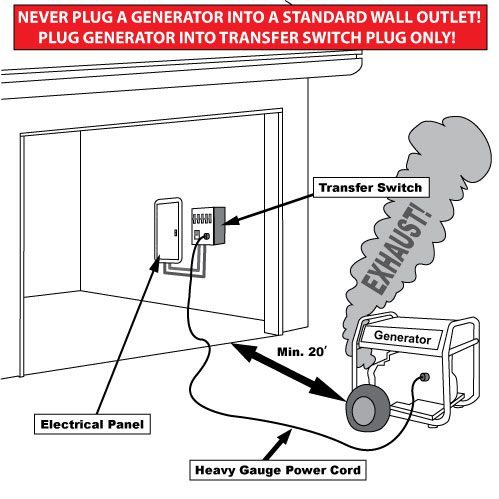 Do not use gasoline-powered machinery, such as generators in any enclosed space! Toxic fumes kill! Operate generators outdoors. Plug appliances directly into the generator using heavy duty, properly-grounded extension cords that aren’t worn or frayed. Do not connect a generator to your home without use of a professionally installed transfer switch. Learn more about generator safety here.
- Do not use charcoal grills indoors. Dangerous carbon monoxide generated from them and other fuel-burning devices can and do kill people every year.
- Do not use a gas range or oven for room heating. A fuel-burning heater, such as a kerosene heater, requires plenty of ventilation to prevent buildup of harmful fumes. Place heaters on a hard, stable surface away from flammable materials. Never leave children or pets alone when using a portable heater.
- Keep freezer and refrigerator doors closed. Open them only when necessary. Food will usually stay frozen for 36-48 hours in a fully loaded freezer if you keep the door closed. A half-full freezer will generally keep food frozen for 24 hours.
- Turn off lights and appliances. When the lights go out, unplug sensitive electronic devices like computers to avoid a circuit overload when power is restored. Leave one light switch on so you’ll know when service returns.
Outage Information

- For larger outages, the PUD routinely updates its main webpage and social media feeds. Large outages present a obstacles for our substation and dispatch teams, and reports from the field are posted to an advisory bar on jeffpud.org and on our Facebook, Nextdoor pages.
- Subscribe for NIXLE updates from Jefferson County Emergency Management. NIXLE is a free text and email service providing timely information about regional emergency events. Register here.
- Listen to local radio stations such as KPTZ (91.9 FM) or KSQM (91.5 FM) for emergency management status updates.