A High Wire Act – Animal Outages [VIDEO]
It always seems to happen at night.
At Port Townsend’s Dana Robert Substation, the transformer hums quietly after a long day powering ~2,500 customers. Beneath the lights, 12,470 volts flow silently through the distribution system. For now, all is calm.
But an intruder is lurking in the darkness.
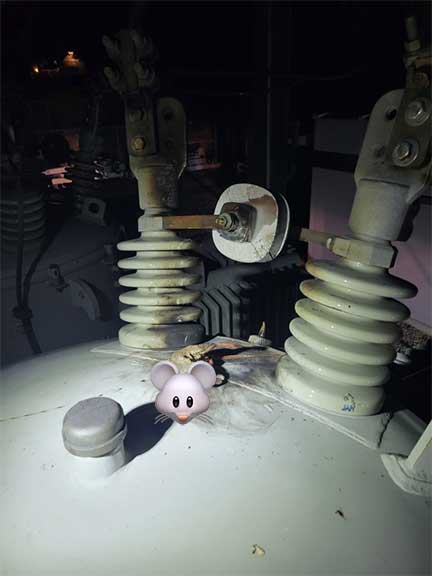
A rat has squeezed through the fence, scaled a voltage regulator with the goal (presumably) to high wire across the substation to greener pastures. As it began climbing it inadvertently became the contact point between terminals. What happened next was not only visible, but could be heard some distance away as protective equipment engaged and the substation (and surrounding service area) went dark.
Animal-related outages within substations are thankfully a rare occurrence, but an outage presents not only an immediate customer impact, but places additional stress on the expensive substation equipment. The matched set of three regulators shown in the video are relatively new by substation equipment standards, having been install in March of 2025, and carry an approximately $100k price tag each. After a fault occurs, the PUD substation team checks all affected components, including sampling the regulator oil, to ensure the equipment is safe to reenergize. In the case of the Port Townsend outage, substation and line crews had the substation back on line within 2.5 hours.
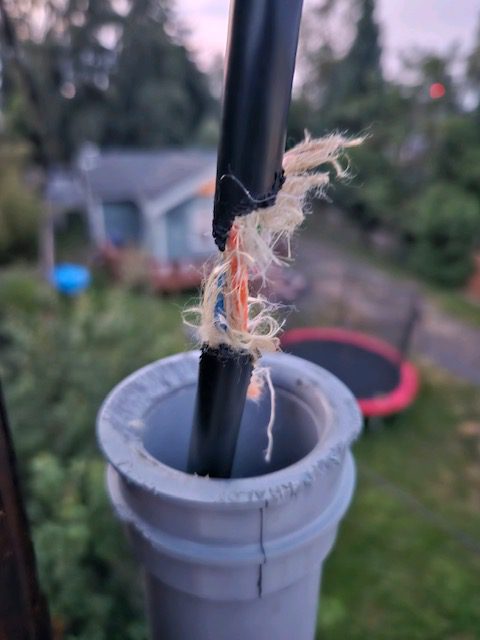
The vast majority of wildlife-involved outages occur in rural areas and are most frequent during specific times of the year. Spring, for example, finds birds and small mammals building nests on or around pole-mounted transformers, which can easily lead to inadvertent contact. During the fall and early-winter, small mammals like squirrels stock up food and routinely traverse utility lines and scale poles and transformers for a perch. Rats on the other hand…they are a year-round threat and have been known to scale utility conduit to feast upon the (apparently) delicious coating of newly-strung fiber optic cable and other components.
From January – August of 2025, animal-related outages rank as the second highest outage cause countywide, accounting for ~8% of all customer hours without power (67 outages total as of August 19th). Not surprising, trees are largest outage culprit, making up 34% of all outages thus far in 2025. It’s worth noting that the overall number of animal-cause outages could be considerably higher as the outage category listed as “unknown”–meaning line crews were unable to note a true, definitive cause–makes up about 31% of the overall total.
Thankfully, animal-related outages have decreased in recent years. In 2017, for example, crews identified 13% of all outages caused by critters.
Jefferson PUD substation and line crews work to mitigate against animal-line contacts by installing covers around transformer and regulator connection points, but small animals can still manage to find ways around these devices. There is also the scale of mitigating against animal contacts to consider. JPUD has 8,100 transformers in service and approximately 10,000 poles to maintain–that’s a lot of potential for animal high wire acts and contact.