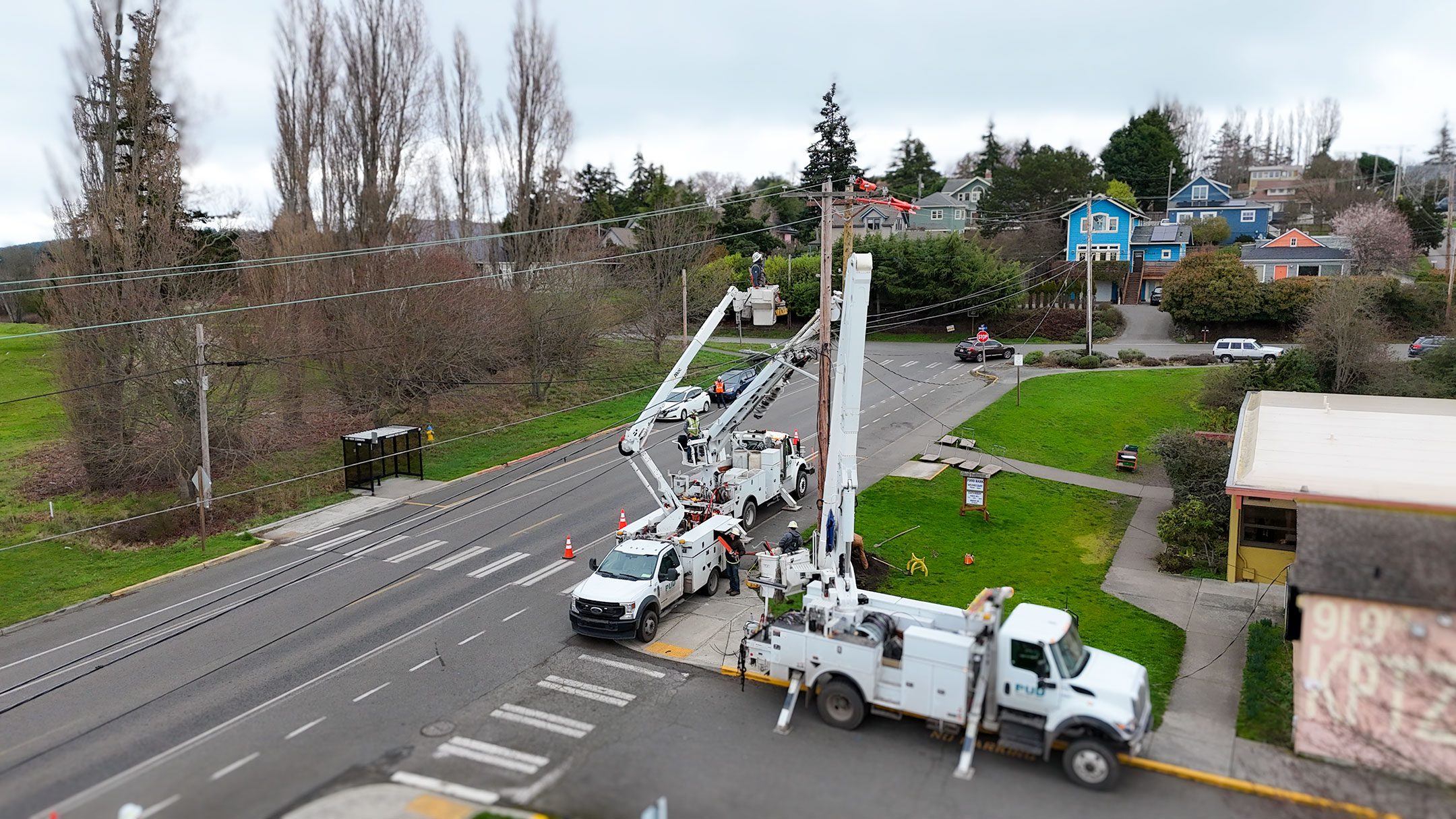
Trading Timber: Reliability One Pole at a Time
Routine inspections of utility poles help prioritize replacements, making our nearly 400 miles of aboveground lines safer for both the public and line crews.
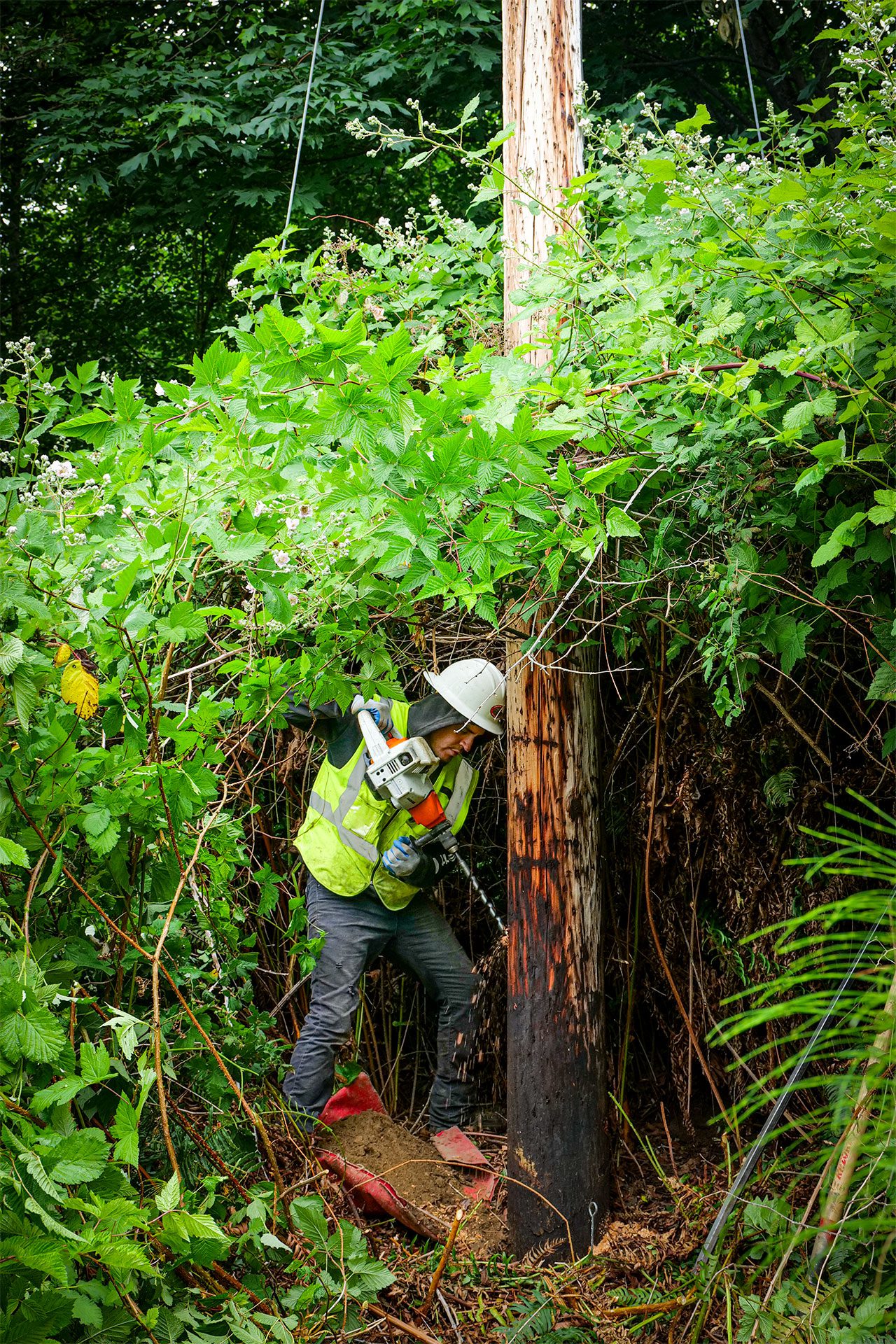
Contract inspection teams check approximately 1,000-1,300 poles annually with the goal of a complete pole inventory every 10 years. The inspection process often requires bushwhacking through roadside brush to gain access before the work truly begins.
A visual survey is conducted, focusing on malicious attacks by woodpeckers, fine wood dust from boring insects, and weather damage typically in the form of a rotten, jagged pole top. A pole may look fine from the outside but inside may tell a whole different story. A quick “sounding test” (lightly hammering the exterior of the pole), and a well-trained ear, often tell what lies inside.
Internal testing involves 3 bore holes into the pole at various heights—below ground to ~18”, at ground level, and aboveground 24”. Each bore is angled at approximately 45 degrees to provide the tester a larger sample area.
Testing the internal structure requires a delicate, seasoned touch. A metal feeler gauge with a lightly curved end is inserted into each bore hole and drug along the sides to determine the internal structure. A soft, punky center where fibrous pieces come out with the gauge signifies rot or bug damage to the heart wood (center) of the pole—larger pieces of wet wood pulled from the bore can indicate water intrusion and rot. While on site, crews inspect approx 60-70 poles per day. Once inspected, the team fills each bore hole with preservative designed to ward off insects and rot.
Next, our PUD engineers review the pole. The most recent survey in the Port Townsend area revealed numerous poles to address. Utility poles work together as a system, supporting power lines, transformers, communication lines, and other equipment. Each attachment adds weight and stress to the pole and nearby poles. Engineers confirm the pole’s capacity and issue work orders to ensure everything is properly supported.
Work order in-hand, line crew prep the replacement pole, while metering staff conduct a locate at the site, identifying any additional underground utilities in the area. On average, PUD line crews can replace 1-2 poles per day, depending on the type of pole and its location.
Placing a pole requires a new hole, with the old pole often being cut off below ground after the new one is set–this is referred to as a ‘cut-and-kick’. With the derrick digger and it’s 16” auger positioned, the line crew begins the task of boring-down. How deep depends upon the height of the pole–a 45’ pole will be about 6.5’ underground, while a 75’ transmission pole might be closer to 9.5’.
Slowly, carefully, the auger churns up the earth, which is placed nearby on a ground cloth to refill around the new pole. Minutes later, the same armature supporting the auger bit transforms, revealing a large claw at the end of the boom. A lifting chain is placed around the pole and it is hoisted airborne, guided into place by the line crew and securely held in the vertical position by the claw.
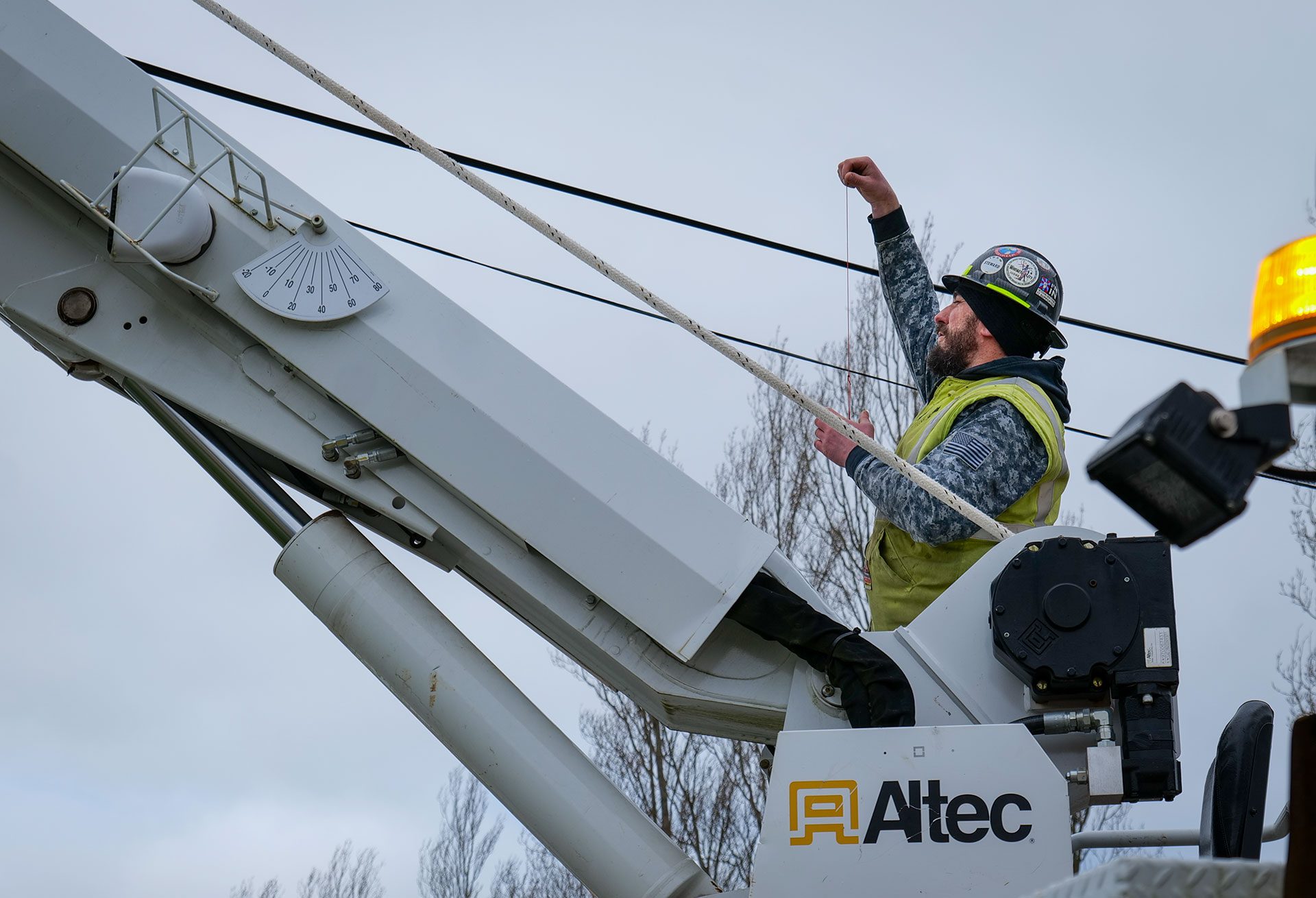
This is where modern technology meets old-school Pythagorean theorem. A traditional plumb bob is used to check the pole for level before being filled in.
Crew backfill the hole and use a long handheld air ram to pack the dirt around the pole. Aboveground, lines are secured and down-guy support wires are installed–these are the wires extending from the midpoint of a pole that connect to a ground-based anchor to better support the pole on corners or tricky terrain.